
Indiana County Bankruptcy Records
Indiana County bankruptcy records are public federal documents filed with the U.S. Bankruptcy Court for the Western District of Pennsylvania. Indiana is the county seat and is also known as the birthplace of actor Jimmy Stewart. The county has a population of about 85,000 and sits roughly 50 miles northeast of Pittsburgh. Residents file bankruptcy cases at the Pittsburgh office of the Western District court. Records cover all Chapter 7 liquidation cases, Chapter 13 repayment plans, and Chapter 11 reorganizations. You can search these records through PACER online, by phone through VCIS, or in person at the Pittsburgh courthouse.
Indiana County Quick Facts
Indiana County Bankruptcy Court Location and Hours
Indiana County is part of the Western District of Pennsylvania. Bankruptcy cases from Indiana County are filed with the Pittsburgh Division of that court. Pittsburgh is about 50 miles southwest of Indiana, making it a manageable drive for most residents who need to appear in person. The Pittsburgh courthouse is at the U.S. Steel Tower, Suite 5414, 600 Grant Street, Pittsburgh, PA 15219.
Phone: (412) 644-2700. Hours: Monday through Friday, 9:00 AM to 4:30 PM. Section 341 meetings for Indiana County cases are typically held in Pittsburgh. The court assigns a trustee and a 341 meeting date after your case is filed. The notice you receive by mail will confirm the meeting location and time. The court uses CM/ECF for attorney electronic filing and EDSS for pro se document submission. Judge-specific procedures apply based on which judge is assigned. These procedures are posted by judge name on the court website at pawb.uscourts.gov.
The Western District of Pennsylvania Bankruptcy Court at pawb.uscourts.gov covers all local rules, forms, and filing procedures for Indiana County cases.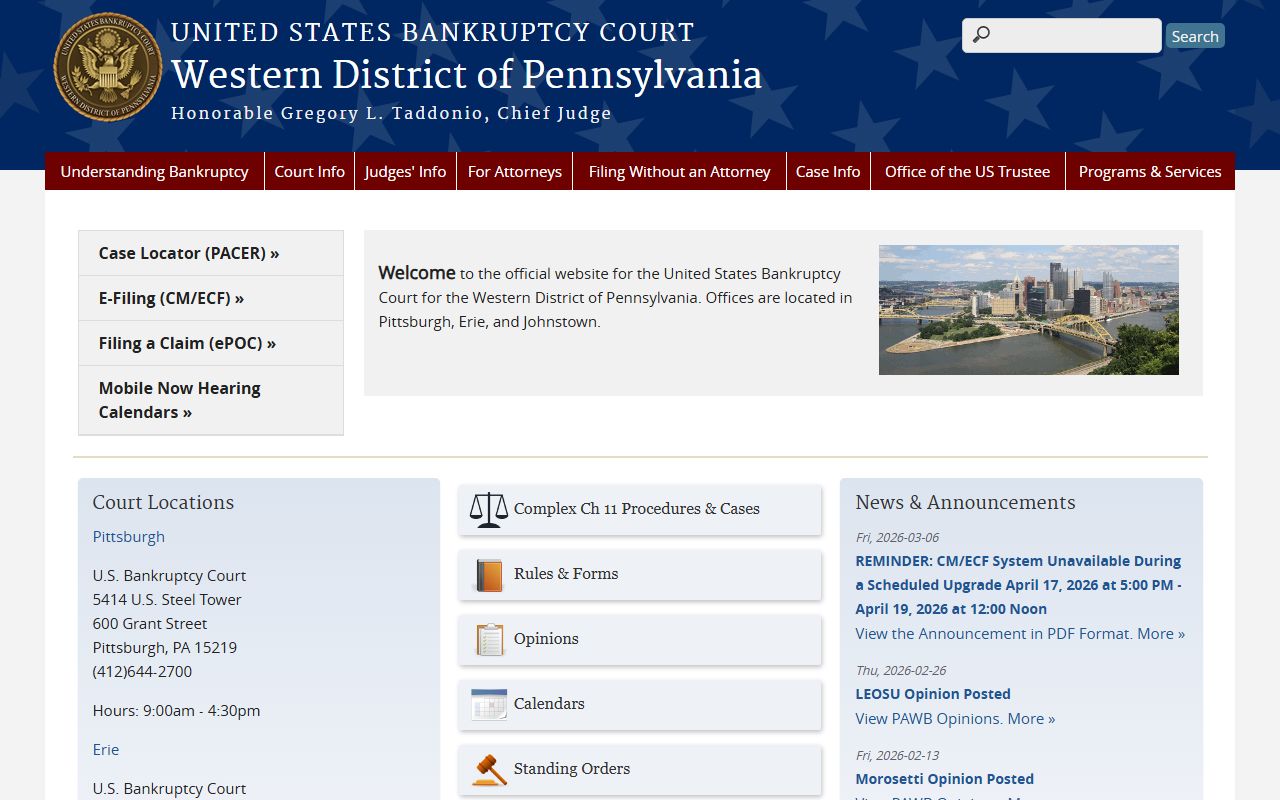
The court site provides all the local rules, filing forms, and judge-specific guidance that Indiana County filers and attorneys need to navigate the case process.
| Court |
U.S. Bankruptcy Court Western District of Pennsylvania U.S. Steel Tower, Suite 5414 600 Grant Street Pittsburgh, PA 15219 Phone: (412) 644-2700 |
|---|---|
| Hours | Monday through Friday, 9:00 AM to 4:30 PM |
| 341 Meetings | Pittsburgh, typically 21 to 40 days after filing |
| VCIS | 1-866-222-8029, extension 78 |
| Website | pawb.uscourts.gov |
Accessing Indiana County Bankruptcy Records Online
PACER is the primary online tool for searching Indiana County bankruptcy records. It is run by the federal judiciary and holds every document from every federal bankruptcy case in the country. Registration is free. Access is available around the clock.
Create a free account at pacer.gov to search Indiana County bankruptcy records immediately.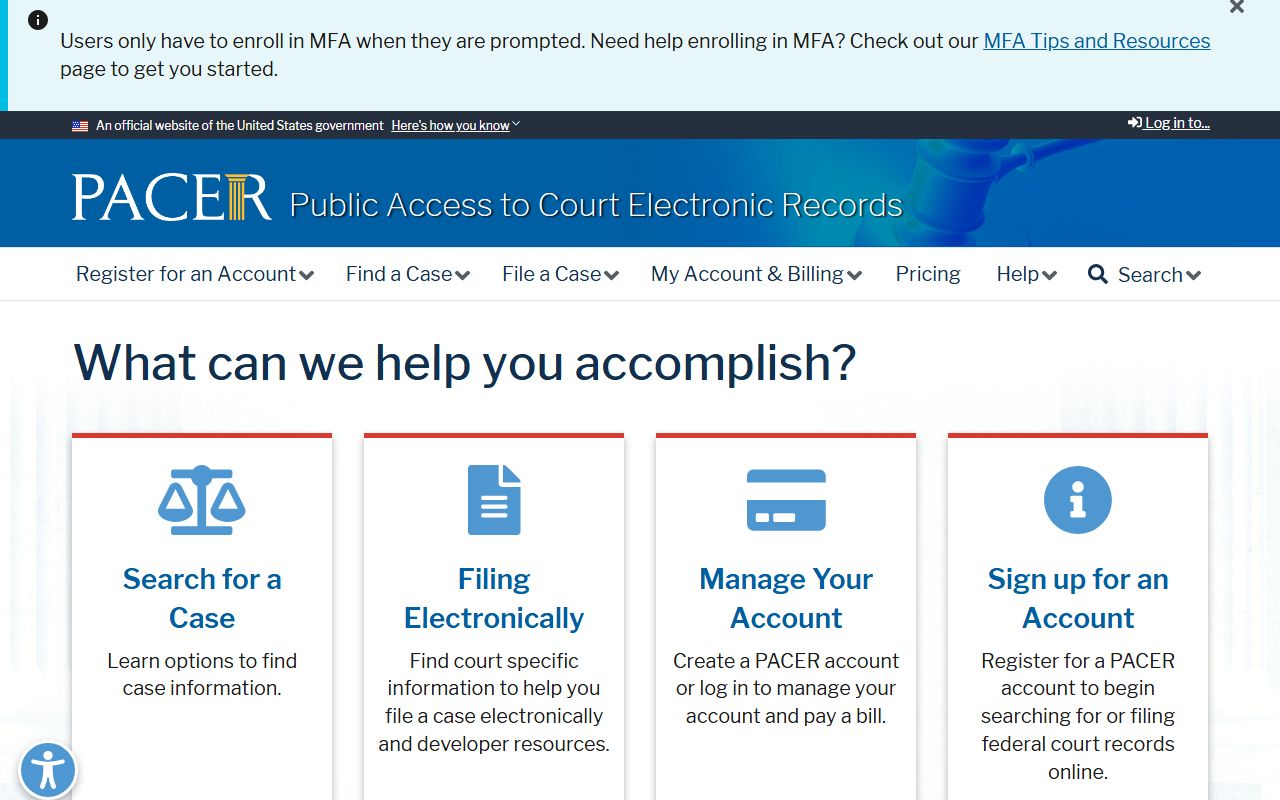
PACER lets you search Indiana County cases by name, case number, or Social Security number and view the complete docket of any case at any time.
Search by debtor name, the last four digits of a Social Security number, or a case number. PACER shows the full docket once you locate a case. You can download any document in the case. The cost is $0.10 per page with a cap of $3.00 per document. Quarterly charges under $30 are waived, making PACER free for most users who search occasionally. The PACER Case Locator also lets you run searches across all federal districts at once when you are not sure which court holds a particular case.
The Voice Case Information System at 1-866-222-8029, extension 78, gives free automated case status updates by phone. No account is required. Call and enter the debtor name or Social Security number when prompted. You hear the case number, filing date, trustee name, and discharge or dismissal status. This is a quick, no-cost way to check on a specific Indiana County bankruptcy case.
Note: Public terminals at the Pittsburgh courthouse allow free PACER access during business hours for those who prefer in-person access.
Bankruptcy Options for Indiana County Residents and Businesses
Indiana County residents and businesses can file under Chapter 7, Chapter 13, or Chapter 11. The best choice depends on income, the type of debt, and whether you want to keep specific assets.
Chapter 7 liquidation is the most commonly filed chapter in Indiana County. It provides a relatively fast discharge of most unsecured debts. The process takes about four months from filing to discharge. You must qualify through the means test, which measures your average monthly income over the six months before filing against the Pennsylvania median for your household size. Pass the test and most of your unsecured debt can be wiped out. The filing fee is $338. The trustee reviews your property list, but most individual filers in Indiana County have all their assets protected by exemptions. Chapter 7 is often the best fit for people whose income is modest and whose debts are primarily medical bills, credit cards, or personal loans.
Chapter 13 is a structured repayment plan lasting three to five years. It is the right choice for Indiana County residents who are behind on a mortgage and want to save a home from foreclosure. It is also useful for people who have non-exempt assets they want to keep, or tax debts they need to repay in an organized way. You propose a plan, the court approves it, and you make monthly payments to the trustee. After completing the plan, remaining eligible debts are discharged. The filing fee is $313.
Chapter 11 reorganization is typically used by businesses, but it is available to individuals with debt above the Chapter 13 limits. Indiana County has both small businesses and individual residents who may qualify. All three chapters trigger the automatic stay under 11 U.S.C. § 362 the moment the petition is filed. The stay stops all collection actions, lawsuits, wage garnishments, and foreclosure proceedings immediately.
Indiana County Court Records and Bankruptcy
Indiana County maintains local public records that often come up when preparing a bankruptcy petition. These offices are at the Indiana County Courthouse, 825 Philadelphia Street, Indiana, PA 15701.
The Indiana County government website at indianacountypa.gov lists all county offices, departments, and online services available to residents.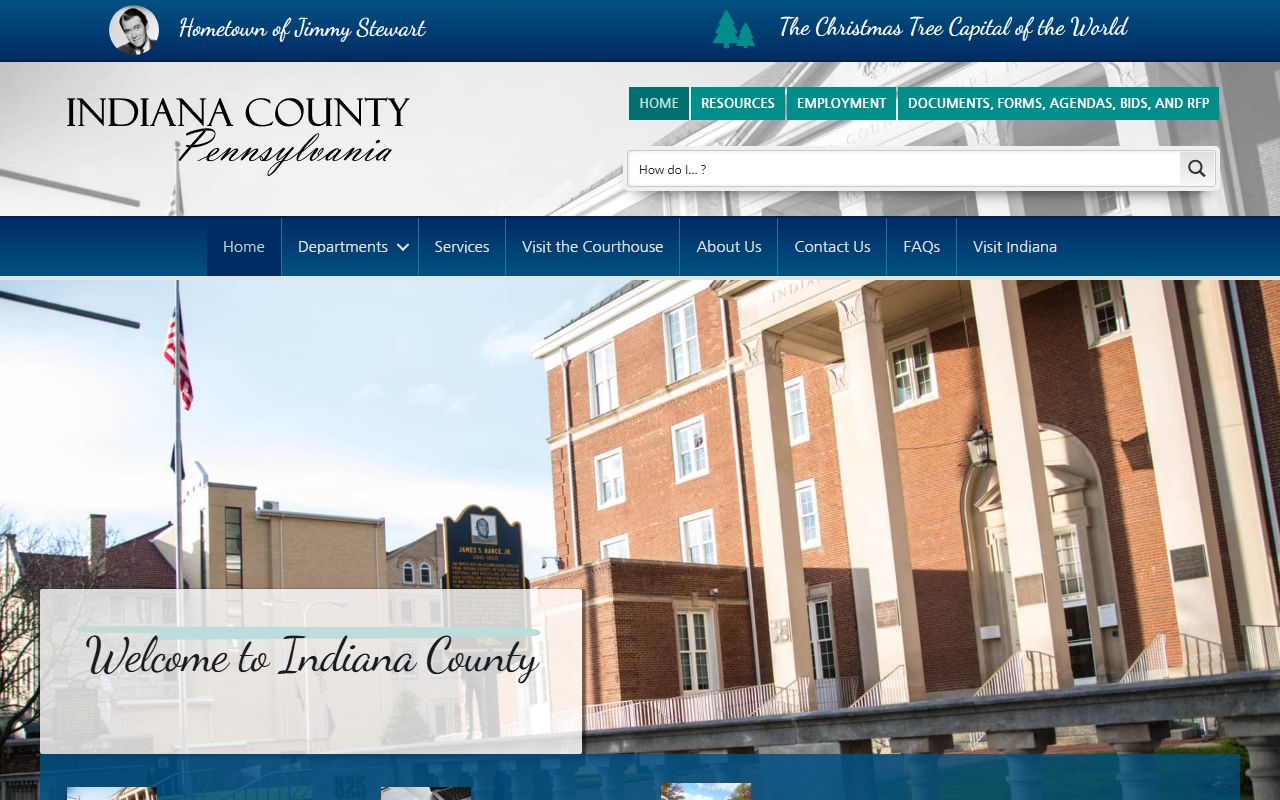
The county website connects you to the offices that hold property records, civil court records, and estate information relevant to your bankruptcy filing.
The Indiana County Prothonotary at (724) 465-3855 keeps civil court records including judgment liens. Judgment liens recorded against real property in Indiana County must appear on your bankruptcy schedules as secured debts. The Recorder of Deeds at (724) 465-3860 maintains deeds, mortgages, and property liens. These records are essential when preparing Schedule A/B and Schedule D in your bankruptcy petition. The Register of Wills at (724) 465-3856 holds estate records. Inheritance interests that arise within 180 days of your filing date are property of your bankruptcy estate.
The Prothonotary office at indianacountypa.gov/departments/prothonotary allows online record searches and provides information on obtaining certified copies of civil judgments.
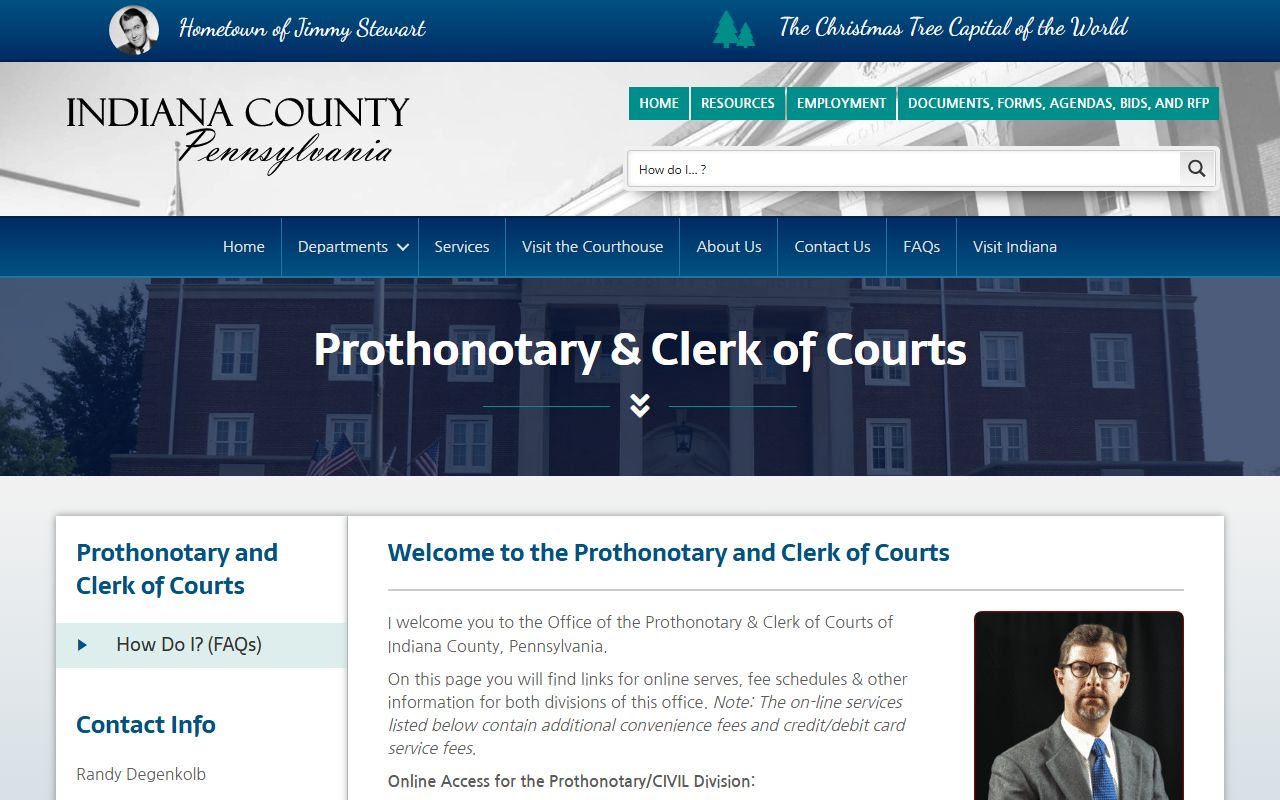
The Prothonotary records are searchable online by party name and docket number, making it straightforward to identify any judgment liens that could affect your bankruptcy case.
Bankruptcy Exemptions for Indiana County Filers
Pennsylvania gives you a choice of state or federal exemptions when you file for bankruptcy. The choice affects how much of your property you keep. You must decide before filing and stick with that choice for the entire case.
Pennsylvania state exemptions are very limited and poorly suited for most property owners. The primary protection is a $300 wildcard under 42 Pa.C.S. § 8123 that can apply to any personal property. Pennsylvania has no homestead exemption and no vehicle exemption in state law. An Indiana County homeowner with $50,000 in home equity gets zero protection for that equity under state exemptions. The same is true for vehicle equity.
Federal exemptions under 11 U.S.C. § 522(d) are far more protective and are the better choice for most Indiana County residents who own a home or a car. The federal homestead exemption covers up to $27,900 in equity in your primary residence. The vehicle exemption covers up to $4,450 in one motor vehicle. A federal wildcard exemption can protect additional property of your choice. Federal exemptions also protect household goods up to $700 per item, retirement accounts, tools of trade, and life insurance. Indiana County has a mix of suburban, rural, and small-town residents, many of whom own homes and vehicles that benefit significantly from the federal exemption package.
Note: Pennsylvania does not allow you to mix state and federal exemptions in the same case, so choosing the right set from the start is essential.
Filing for Bankruptcy from Indiana County
The bankruptcy filing process from Indiana County follows the same federal rules that apply across Pennsylvania. Preparation is the key to a smooth case.
Credit counseling comes first. You must complete a course from a U.S. Trustee-approved agency within 180 days before filing. The course is available online or by phone from most approved providers, so Indiana County residents do not need to travel. You get a certificate at the end that must be attached to your bankruptcy petition. Filing without this certificate will result in rejection of your petition.
Next, you prepare your petition and all supporting schedules. The schedules are detailed forms that list every asset you own, every debt you owe, your monthly income, and your monthly expenses. You also report recent financial transactions including payments to creditors made in the last 90 days, transfers of property, and any lawsuits. Prepare these carefully because the trustee reviews them closely at the 341 meeting.
File your complete petition package with the Western District court in Pittsburgh. The filing fee is $338 for Chapter 7 or $313 for Chapter 13. After filing, the court schedules your 341 meeting within 21 to 40 days. Attend in person and answer the trustee's questions truthfully. For Chapter 7, the discharge order comes roughly four months after filing. For Chapter 13, you make monthly plan payments for three to five years and receive your discharge after completing the plan. The discharge under 11 U.S.C. § 524 permanently prevents creditors from collecting on discharged debts. Certain debts listed in 11 U.S.C. § 523 are excepted from discharge.
Legal Aid and Attorney Resources in Indiana County
Indiana County residents have access to several legal aid organizations and attorney referral services that can help with bankruptcy cases.
Northwestern Legal Services at northwesternlegal.org provides free civil legal assistance to income-eligible residents of Indiana County and surrounding areas. Their services include bankruptcy counseling, document preparation assistance, and in some cases full representation. Eligibility is based on household income at or below 125% of the federal poverty guidelines. Contact their intake line to find out if you qualify and to schedule an appointment.
The Indiana County Bar Association can connect Indiana County residents with private bankruptcy attorneys who practice in the Western District. Contact the Indiana County Courthouse at 825 Philadelphia Street for the Bar Association's current contact information. The Pennsylvania Bar Association's statewide referral service at (800) 692-7375 is another option. Many bankruptcy attorneys who handle Western District cases accept clients from Indiana County. A first consultation can help you decide whether to file, which chapter is right for you, and how to protect the most property under the available exemptions.
Note: Debtor education from an approved provider is required after filing and before discharge. Most approved courses are available online or by phone for Indiana County residents.
Nearby Counties
Indiana County borders Allegheny, Armstrong, Cambria, Clearfield, Jefferson, and Westmoreland counties. Several of these are in the Western District and also file in Pittsburgh. Check with the court clerk if you are near a district boundary.